If your teenager has brought home a brochure, a counselor has mentioned it at an info night, or you have seen the acronym floating around in school district emails, you have probably wondered what CTE actually means. The term gets used a lot and explained clearly almost never.
By the end of this article you will know exactly what a CTE high school is, how it differs from a traditional high school, what your teen would actually do during a CTE school day, and what questions to ask before making any decisions.
CTE Stands for Career and Technical Education
Career and Technical Education is an approach to high school that mixes standard academic coursework with focused, hands-on training in a specific career field.
A CTE student still takes English, math, science, and history.
What changes is that a meaningful portion of their school day is spent in labs, workshops, or training environments learning skills that connect directly to real jobs.
The “technical” in Career and Technical Education is worth pausing on. It does not mean vocational in the outdated sense of the word.
CTE programs today cover healthcare, information technology, aerospace, engineering, finance, digital media, and dozens of other fields. The old image of shop class and auto repair is about 30 years out of date.
In Texas, the state organizes CTE into 16 career clusters. Each cluster represents a broad industry sector, and within each cluster there are specific programs of study with defined course sequences, skills benchmarks, and in many cases industry certifications students can earn before they graduate.
What Does a CTE School Day Actually Look Like?
This is usually the first question parents ask after they understand the basic concept, and it’s the right one.
At a CTE high school, a student typically starts the day with core academic classes (math, English, history, and science). The difference is in what fills out the rest of the schedule.
Depending on the program, a student might spend part of their day in a lab working on a real project, in a simulator practicing a skill, in a workshop building or repairing something, or in a classroom environment where the instruction is directly tied to a career field rather than a general curriculum.
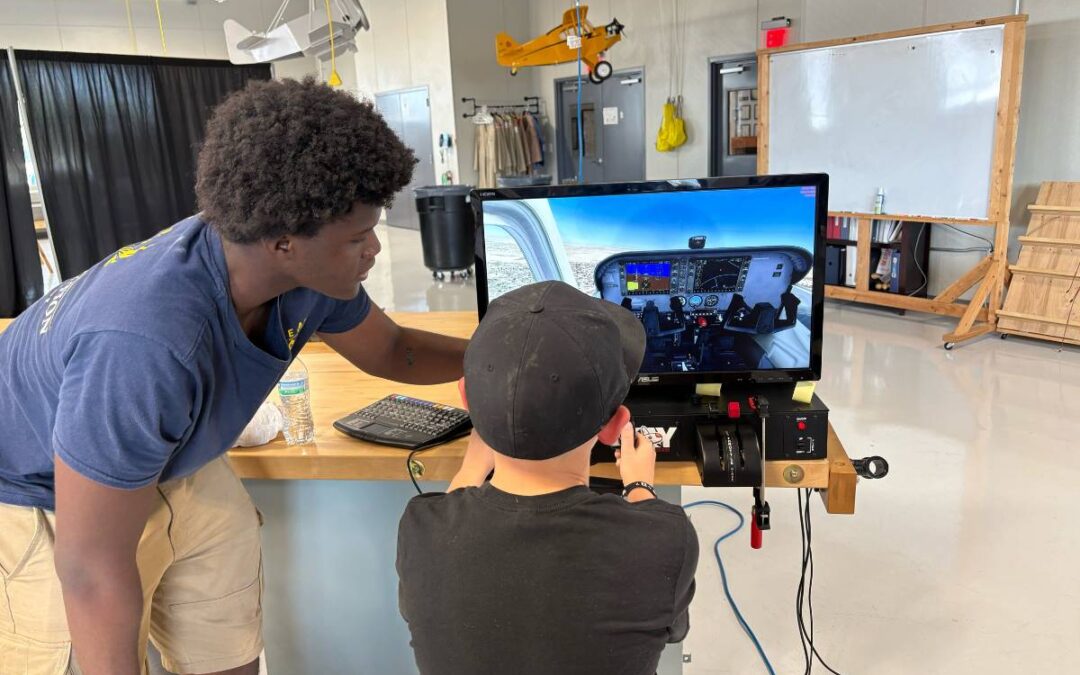
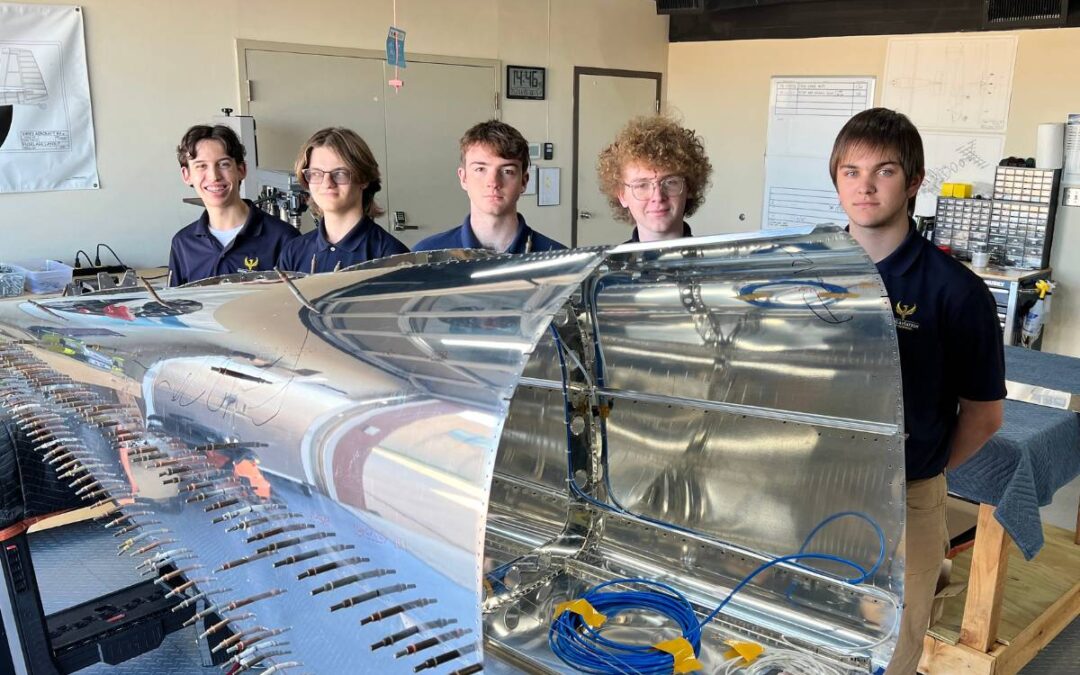
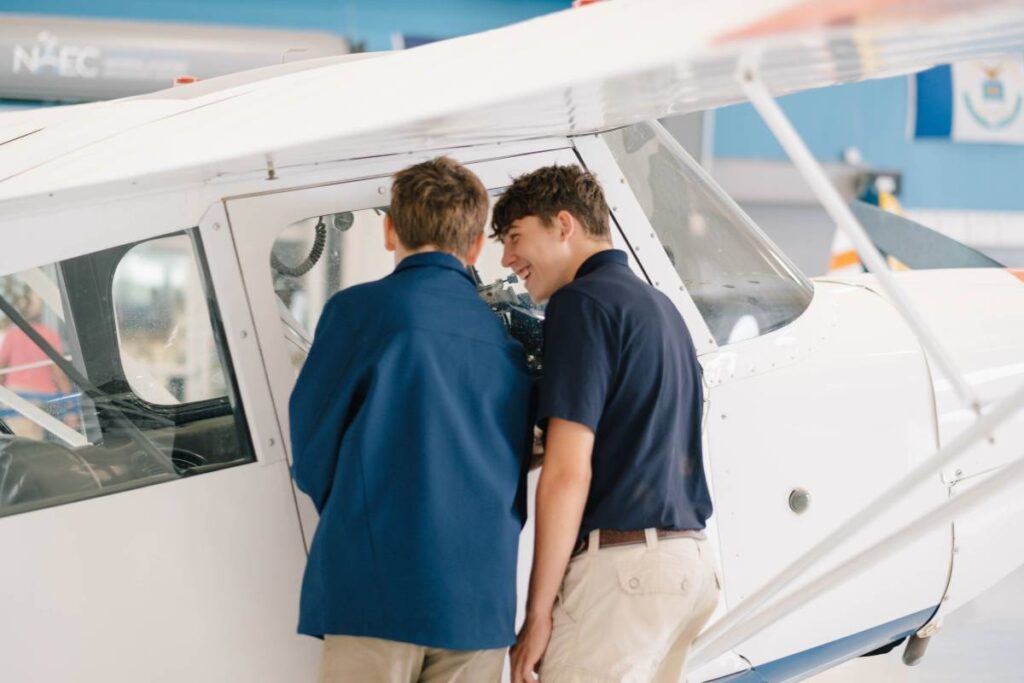
At Rising Aviation High School, for example, a student might move from an academic class to a session in the flight simulator or to the maintenance hangar where they are working on an actual aircraft alongside classmates.
The subjects are still connected to academic standards, but the context is aviation throughout.
By the time a student graduates, they may hold a private pilot certificate, a drone pilot certificate, or be on a clear pathway to an FAA Airframe and Powerplant certificate, depending on which track they chose.
That is what makes CTE different in practice. It is not just a different style of teaching. It is a different relationship between what you learn in school and what you can do when you leave it.
CTE Schools vs. Traditional High Schools
Parents often assume the differences between CTE schools and traditional high schools are mostly philosophical. But they are actually structural.
How learning is organized.
Traditional high schools are built around academic subjects. Every student moves through the same general course requirements, and career exploration tends to happen on the margins through counselors, elective choices, or extracurriculars.
CTE programs are built around a career pathway that runs through the student’s entire schedule. The academic courses exist alongside the technical training, not separate from it.
What students produce.
In a traditional high school, most of what a student creates is assessed through test scores.
In a CTE program, students often produce work that has real-world relevance. A student in an aviation maintenance program might spend months working on an aircraft that will eventually be airworthy.
A student in a healthcare CTE program might earn a certified nursing assistant credential that is valid in the real job market.
The path to the workforce.
A student who graduates from a traditional high school with strong grades is well-positioned for college admission but typically needs four or more years of additional education before they can enter most skilled careers.
A CTE graduate in a well-designed program can enter the workforce immediately, continue into a related college program with credits already in hand, or both.
Class size and environment.
CTE programs, especially those at dedicated schools rather than comprehensive high schools, tend to run smaller. Smaller cohorts mean more direct instruction time and a different social environment.
What About College?
This is the question that comes up more than any other, and it is worth answering directly.
CTE does not close the door to college. In many cases it opens more doors than a traditional path does.
Research published by the Association for Career and Technical Education found that students who take both CTE coursework and college preparatory courses are better prepared for college and careers than students who take only college prep.
The combination, not one or the other, produces the best outcomes.
In Texas specifically, many CTE programs offer dual enrollment options, meaning students can earn college credit while still in high school.
Industry certifications earned through CTE programs carry real weight in college admissions because they demonstrate practical competence rather than just academic performance.
The Embry-Riddle Aeronautical University pathway available to Rising Aviation students is a concrete example of how this works.
Students who complete the program are not set back from college. They arrive at aviation programs with documented flight hours, technical credentials, and hands-on experience that traditional applicants do not have.
The legitimate concern is not whether CTE students can get into college.
It is whether the specific program a student enters is a good one with clear pathways documented and real outcomes. A weak Career and Technical Education program at a school that treats it as an afterthought is not the same thing as a well-designed CTE program at a school built around it. The quality of the program matters more than the label.
The Different Types of CTE Programs in Texas
Not all CTE education looks the same, and the differences matter.
CTE courses inside a traditional public high school.
Most large Texas public high schools offer some CTE courses, usually as electives students can fold into an otherwise traditional schedule.
A student might take one or two CTE classes per year alongside a standard course load. This is the most common form of CTE in Texas, and it ranges from genuinely rigorous to barely distinguishable from a standard elective.
CTE magnet schools and academies.
Some districts run dedicated magnet programs or career academies where the entire school is organized around one or more career themes. Students apply to get in, and the program runs deeper than a few elective courses.
Comprehensive CTE centers.
Some districts operate standalone CTE centers where students spend part of their day getting technical instruction, then return to their home campus for other classes. These tend to offer more serious depth than a single elective but less integration than a dedicated school.
Dedicated CTE high schools.
A smaller number of schools, including private options like Rising Aviation High School, are built entirely around a CTE focus. Every student is there because of the program. Academic and technical instruction are fully integrated rather than running on separate tracks. These schools tend to offer the deepest experience but require families to make a more deliberate choice.
The question for parents is not just whether a school offers CTE but how seriously it treats it. A school where CTE is a genuine institutional priority looks different from one where it is a line item in the course catalog.

What Texas Law Requires
Texas high school students are required to earn credits in specific areas to graduate, and CTE credits can count toward those requirements in certain cases. The Texas Education Agency has structured CTE around programs of study that include coherent course sequences tied to real career pathways and industry certifications.
Under the state’s graduation frameworks, students on the Foundation High School Program must earn two credits in CTE or an additional language beyond the basic requirements.
Students aiming for endorsements, such as the STEM endorsement, the Business and Industry endorsement, or the Arts and Humanities endorsement, can use CTE coursework to satisfy those endorsement requirements.
For students at private CTE schools, the landscape is slightly different.
Private schools in Texas set their own graduation requirements, though accredited institutions follow frameworks that meet or exceed state standards.
Students who earn industry certifications through a private CTE school carry those credentials regardless of whether the credits transfer directly into the state’s public school system.
Is a CTE High School Right for Your Teen?
CTE programs work best for teens who learn by doing rather than by reading and sitting, who have a clear or emerging interest in a career field, who feel disengaged from the traditional academic environment, or who want to graduate with something more tangible than a transcript.
They can be a poor fit for students who have not yet identified any career interests and would benefit from a broad exploratory environment. Or for students whose primary goal is a highly competitive traditional college admission and whose academic record is the most important variable in that process.
The good news is that these categories are not mutually exclusive.
A motivated student who chooses a well-designed CTE program, takes the academic side seriously, and earns meaningful credentials along the way often outperforms peers on both dimensions, they are better prepared for work and better prepared for college than students who only did one or the other.
What Rising Aviation High School Offers as a CTE School
Rising Aviation is a private, accredited CTE high school located on the campus of Addison Airport in Dallas. Students earn a high school diploma while working toward one of three technical pathways:
The school is small by design. That is not incidental. Small class sizes mean instructors can work with individual students rather than managing a room of thirty. Students who need more time on a concept get it. Students who are ready to move faster can.
The technical training at RAHS is genuine.
Students who enter the fixed wing program work toward a private pilot certificate with a real flight school, Thrust Flight, based at Addison Airport.
Students in the maintenance program work on actual aircraft, including a Van’s RV-12 the current student cohort has been building from a kit. These are not simulations of CTE. They are the real thing.
If your family is exploring whether a CTE high school is the right move, the best next step is to see one in person.
You can schedule a tour of Rising Aviation at risingaviation.com/contact-us, or call the school at (469) 206-3048.
Quick Reference: CTE Terms Parents Encounter
CTE concentrator.
A student who completes two or more approved CTE courses for credit in a defined sequence. This is the term Texas uses to identify students who are genuinely embedded in a CTE pathway rather than just taking a single elective.
Program of study.
A structured sequence of courses within a career cluster that prepares students for a specific career pathway. Think of it as a multi-year plan that builds skills progressively rather than a collection of unrelated classes.
Industry-based certification (IBC).
A credential issued by an industry body, not a school, that certifies a student meets a professional standard. In aviation, examples include the FAA Private Pilot Certificate and the FAA Part 107 Remote Pilot Certificate for drone operators.
Dual enrollment.
An arrangement where a high school student takes a college course and earns both high school and college credit for it simultaneously. Many Texas CTE programs offer dual enrollment options through community college partnerships.
Career cluster.
A broad grouping of related careers used to organize CTE programs of study. Texas uses 16 federally defined career clusters ranging from Agriculture and Health Science to Transportation, Distribution, and Logistics, which is the cluster that includes aviation.